Cool stuff only

In my current campaign I started out using the random tables for treasure found in the Dungeon Master’s Guide (DMG). The DMG suggests giving out one treasure hoard per session. A CR0-4 hoard consists of 2d4x100 GP and 1d4-1 magic items that are then rolled on a separate table.
I have two major problems with this procedure:
1d4-1 magic items are way too few. In a party of 4 it would take an average of 5.3 sessions before every PC had two items each, and a lot of them are consumables. I let my players roll the treasure live during the session and they rolled 1 two sessions in a row, so I ruled it that the minimum amount of magic items is 1. Still, we are faced with the fact that:
The items suck. And I mean suck.
Let’s try together. We need 3 rolls: 1d4 for the type of item, 1d100 for the rarity and 1d100 for the exact item.
2/66/99 → Uncommon Armament: Wraps of Unarmed Power +1
+1 hit/damage on unarmed attacks. This benefits only one specific class.2/82/61 → Uncommon Armament: Quiver of Ehlonna
A quiver holding 60 arrows, 18 javelins etc. This is only relevant if playing with encumbrance, and even then quite weak.4/77/55 → Uncommon Relic: Potion of Greater Healing
4d4+4, avg. 14. Cool if healing potions are rare in your world, otherwise as good as finding a pile of gold.
And let me tell you, we got lucky. Most of the items have minor effects: an armor that won’t get dirty, a spice pouch with spices for 10 meals, a shield with a face that can change expression.
I am actually fine with magic items being hit or miss, but if that is the design intent, the amount of items is way too low. Imagine playing for four hours, cleaning out an ogre cave, and receiving the items above as a reward.
The first time I thought it was just bad luck, after three sessions I felt I was defrauding my players. As a player I would expect a +1 weapon at some point. That would be a 5% chance on the uncommon armaments table. The sword of vengeance is +1 but also cursed, but let’s count it too (another 5%). That’s 10% of 25% (chance of getting an armament) of 47% (chance for an uncommon item) = 1.1%.
This ends the first part. I conclude that the magic item table in the DMG is unusable as presented.
Analysis of + bonus for weapons
Actually, let’s expand on that. So the chance for a +1 weapon is low, but I presupposed that it would be a good hit. My play experience differs, I was generally underwhelmed with hit chance and damage development.
At first level, a +1 weapon increases the hit bonus from probably +5 to +6, a +20% increase of the bonus but emotionally the change feels insignificant. The chance to hit probably increases from something like 60% to 65%, an +8% increase.
I did a simple calculation to compare various weapon bonuses.
Assumptions
Strength 16, which increases to 18 at level 4 and 20 at level 8
Longsword (1d8 damage)
Fighter (or any class with the same extra attacks progression), extra attack at level 5, 11, 20
Monster HP & AC according to Monster Manual 2024 on a Business Card
I compared the following weapons:
Longsword +0, +1, +2, +3
Longsword +0 with an extra 1d6 damage (“LS fire”)
Longsword that automatically hits (“LS true strike")
I use “turns to kill” as the main value since average damage output per turn is meaningless without knowing how many HP an average monster has. Turns to kill is closer to how effective at combat the character feels at the table: we kind of cut through the background math directly to the game reality.
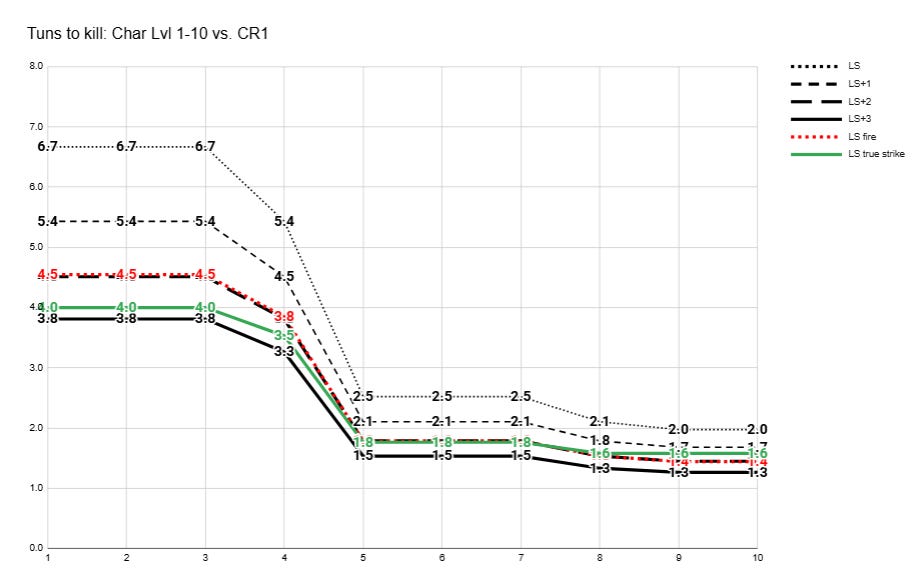
Damage output stays constant through levels 1-3, improves at level 4 due to the primary stat improving to 18 and more than doubles at level 5 as proficiency bonus increases from +2 to +3 and melee classes get a second attack. The best weapon in this graph is the longsword +3, beating both the extra d6 and the true strike swords. The sword with an extra d6 fire damage seems to be comparable to a longsword +2, the true strike sword is only slightly better than a +1 weapon. This makes sense as the hit chance is already high. The lower the chance to hit, the higher bigger the damage increase from the true strike weapon. This is intuitively correct, but I want to understand this further. The next table shows the average chance to hit by character level and challenge rating.
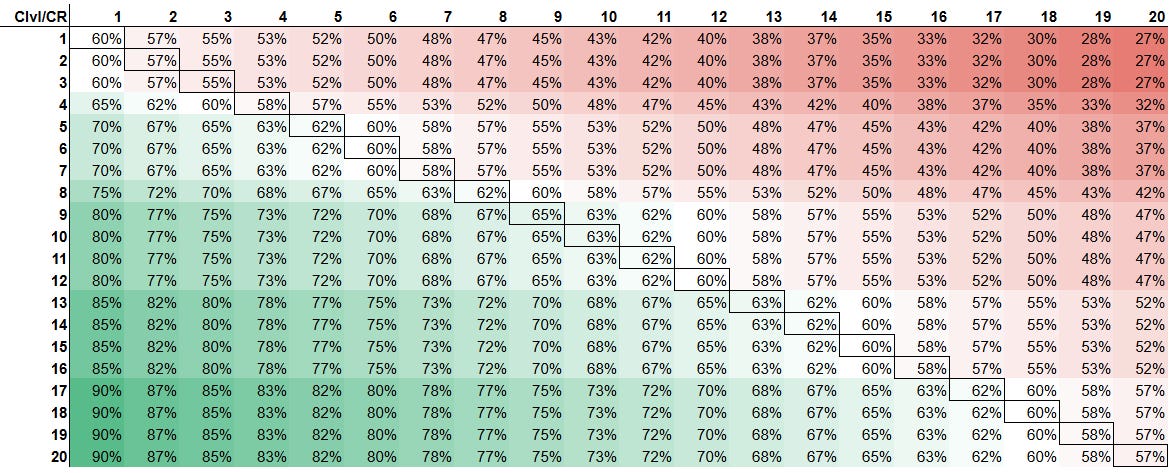
The chance to hit a monster of the same CR is always around 60%, interesting! Increasing this to 100% by equipping a true strike weapon is equivalent to increasing damage by (100-60)/60 = 2/3, or +66%. A level 1 character fighting a CR20 monster increases their damage by (100-27)/27 = +270%, almost quadrupling their damage output.
Throw this out
Why are we even playing around with +1, +2, etc. weapons? Where does this fantasy of incremental advantages come from?
I have a theory that this was basically an accident. +1 magic weapons were much stronger in Chainmail, the combat system suggested in Original D&D (but, as I understand it, not even used by Gygax himself - even more confusing). It seems to me that the magic items were written in a way to apply to both Chainmail-combat and the “alternative” combat rules that became the standard rules in future editions. In Chainmail, a Hero throws 4d6 when attacking and kills most things for each 6 they roll. A magic sword +1 adds 1 to all of the d6s thrown, effectively increasing the kill range 5+, doubling the damage output! Magic swords were also a requirement for battling dragons. So the question becomes “do you already own a magic sword” not just “are you of a high enough level”. This made magic swords extremely strong.
Oh god, all of this is very boring, and unintuitive. The game simply does not make sense to me. I want to throw it all overboard.
“Vengeance on a dumb brute!” cried Starbuck, “that simply smote thee from blindest instinct! Madness! To be enraged with a dumb thing, Captain Ahab, seems blasphemous.”
Ok, but I’m still throwing it all out. Which magic items in stories I know are cool?
The one ring
Sting
The luggage
Iron man suit
Mose’s staff
Tarnkappe
Excalibur
Siegfried bathing in the blood of a dragon
Flying carpet
With such items the user can suddenly go where they have not gone before, change their environments or slaughter their foes (instead of being just a bit more effective in combat). All very exciting.
I will explore this further in the future. Right now my take-away is simple: No more incremental increases.
Cool stuff only.